
Questions about Legionella, Sterilizing-Grade Water Filters and Point-of-Use Water Filters
Sterilizing-grade water filters are often also referred to as Legionella filters. In fact, their function goes far beyond the retention of Legionella. On this page, we answer frequently asked questions about the selection, use and service life of water filters as well as about Legionella, Pseudomonas, E. coli and other water-associated microorganisms.
Filteria specializes in sterilizing-grade water filters and the corresponding connection solutions. In addition to Pall Medical AquaSafe and QPoint filters, we offer our own adapter and shower solutions as well as personal advice on filter selection and installation.
FAQ Overview
Questions about selection, ordering and use
- Which water filter is suitable for my application?
- What is the difference between AquaSafe and QPoint?
- Which Pall filters have a service life of up to 3 months?
- Is there an affordable shower set with a 3-month service life?
- Which universal adapter set does Filteria offer for filters from different manufacturers?
- Do I need a quick connector or adapter?
- Which AquaSafe filter replaces my previous Kleenpak filter?
- How long can I use a sterilizing-grade water filter?
- Why do sterilizing-grade water filters have to be replaced regularly?
- Why can pure litre ratings be problematic when specifying filter life?
- What can reduce the flow rate of a sterilizing-grade water filter?
Questions about Legionella and water hygiene
- Where do Legionella come from?
- Why are Legionella filters used?
- Do these filters only retain Legionella?
- What is a sterilizing-grade water filter?
- What does point-of-use water filter mean?
- How does a sterilizing-grade water filter work in simple terms?
- Why should there ideally be no shower hose downstream of the filter?
- What is retrograde contamination?
- Why can changing a filter be hygienically critical?
- Is a sterilizing-grade water filter only a temporary solution?
- What is the difference between a water filter and a sterilizing-grade water filter?
- What is the difference between a BRITA filter and a sterilizing-grade water filter?
- What should I know about activated carbon filters?
- Is the water fully sterile after passing through a sterilizing-grade water filter?
- What should I consider when using tap water abroad?
Questions about selection, ordering and use
Which water filter is suitable for my application?
Which filter is suitable depends primarily on where it is to be used: on a shower with a shower hose, at a washbasin, at a fixed wall or ceiling outlet, or as an inline filter.
The desired maximum service life, the existing connection and the required outlet type also play an important role.
If you are unsure which filter and which adapter fit your connection, we will be happy to advise you personally.
Go to our detailed guide for choosing the right water filter
What is the difference between Pall AquaSafe and Pall QPoint?
Pall AquaSafe and Pall QPoint are product ranges for point-of-use membrane filtration of water.
Classic AquaSafe filters are used as complete point-of-use filter units and, depending on the model, have a maximum service life of up to 31 days.
The QPoint range was developed for longer periods of use. Depending on the model, replaceable filter capsules or corresponding filter units with a maximum service life of up to 92 days are used.
Which range is better suited depends on the application, desired service life, type of connection and hygiene requirements.
Which Pall water filters have a service life of up to 3 months?
The Pall QPoint range includes filter models with a maximum service life of up to 92 days, or around 3 months.
These include QPoint filters for washbasins as well as versions with a shower outlet. The longer service life can be particularly useful where filters are intended to remain in use for an extended period.
The same applies to QPoint: the specified service life is a maximum period of use and not a guaranteed minimum operating life.
Does Filteria offer an affordable shower set with a 3-month service life?
Yes. Filteria offers its own shower set based on the Pall QPoint QRC212 sterilizing-grade water filter.
The set combines the QPoint filter with a shower handle developed by Filteria for connection to a standard shower hose.
The QPoint filter used in the set has a maximum service life of up to 92 days, or around 3 months.
The shower set is intended as an affordable option for users who require a point-of-use shower solution with a longer maximum service life.
View the Filteria shower set with Pall QPoint QRC212
Which universal adapter set does Filteria offer for water filters from different manufacturers?
Filteria offers its own universal adapter set for sterilizing-grade water filters for connection to different taps and fittings.
The set includes various connection options and is designed for different thread sizes and connection types.
The aim is to make it possible to connect water filters as flexibly as possible to existing taps as well as suitable wall or ceiling outlets.
The universal adapter set is a separate connection solution and should not be confused with the Filteria shower set.
View the Filteria universal adapter set
Do I need a quick connector or adapter?
For many Pall sterilizing-grade water filters, a suitable quick connector or adapter is required for the initial installation.
The required connection solution depends on the filter model and the existing tap or fitting.
For showers with a standard shower hose, special 1/2-inch connection solutions are available. For washbasins and other fittings, various quick connectors and the Filteria universal adapter set are available.
View quick connectors and adapters
Which AquaSafe filter replaces my previous Kleenpak filter?
The former Pall Medical Kleenpak product range is no longer manufactured. Corresponding AquaSafe filters are available for the well-known Kleenpak models.
| Previous Kleenpak model | Current AquaSafe model | Application |
|---|---|---|
| KAQF4 | AQF4 | Showerhead sterilizing-grade water filter |
| KAQ31F1S | AQ31F1S | Washbasin, bundled water jet |
| KAQ31F1R | AQ31F1R | Washbasin or fixed outlet with spray rosette |
| KAQIN | AQIN | Inline application |
The Kleenpak name is still familiar to many users. For current orders, however, the corresponding AquaSafe model should be selected.
How long can I use a sterilizing-grade water filter?
The maximum period of use is determined by the service life specified by the manufacturer for the respective filter model.
For classic Pall AquaSafe filters, the maximum service life is up to 31 days, depending on the model. QPoint models can have a maximum service life of up to 92 days, depending on the version.
The service life begins when the filter is installed or put into use.
Put simply, you could try to set a world record for continuous showering with a Pall filter: what matters is not only the amount of water that has passed through the filter, but also how long the filter has been installed.
Why do sterilizing-grade water filters have to be replaced regularly?
Sterilizing-grade water filters are not intended for unlimited use.
As the period of use increases, various factors can affect hygiene and operation. One of these is the risk of retrograde contamination from the outlet side of the filter.
The service life specified by the manufacturer is a maximum period of use and not a best-before date or guaranteed minimum operating life.
The filter should be replaced no later than at the end of this maximum service life. The specified performance data apply only to the intended period of use defined by the manufacturer.
Why can pure litre ratings be problematic when specifying filter life?
A statement such as “up to X litres” is difficult for many users to monitor reliably in practice if there is no water meter directly at the filter.
In addition, a pure litre rating does not automatically take account of hygiene risks associated with the length of time the filter has been installed.
For a point-of-use sterilizing-grade water filter, a clearly defined maximum service life is therefore particularly important.
What can reduce the flow rate of a sterilizing-grade water filter?
Actual filter performance and, in particular, water flow can be influenced by the water quality and the condition of the drinking water installation.
For example, biofilm, sand, rust particles or other solids in the pipework can place a greater load on the membrane and reduce the flow rate.
The maximum service life is therefore not a guaranteed minimum operating life. Under unfavourable conditions, an earlier filter change may be necessary.
Questions about Legionella and water hygiene
Where do Legionella come from?
Legionella can occur in water-bearing systems and can multiply under suitable conditions.
Particular attention should be paid to areas where water remains stagnant for extended periods, reaches suitable temperatures or where biofilm forms in pipes and fittings.
Drinking water installations inside buildings are considerably more complex than the main supply pipes operated by water utilities. Branches, rarely used pipes, dead legs, deposits and unfavourable temperatures can create conditions in which microorganisms multiply.
Why are Legionella filters used?
If water-associated microorganisms are detected in a drinking water installation, point-of-use sterilizing-grade water filters can provide an additional microbiological barrier directly at the point of use.
They can, for example, be used during investigation, remediation or monitoring of a drinking water installation.
The measures required in a specific case depend on the findings, the way the building is used and the relevant professional or regulatory requirements.
Do these filters only retain Legionella?
No. The term Legionella filter is widely used, but it describes only one part of the possible range of applications.
Sterilizing-grade water filters with a suitably validated membrane can retain other water-associated bacteria in addition to Legionella.
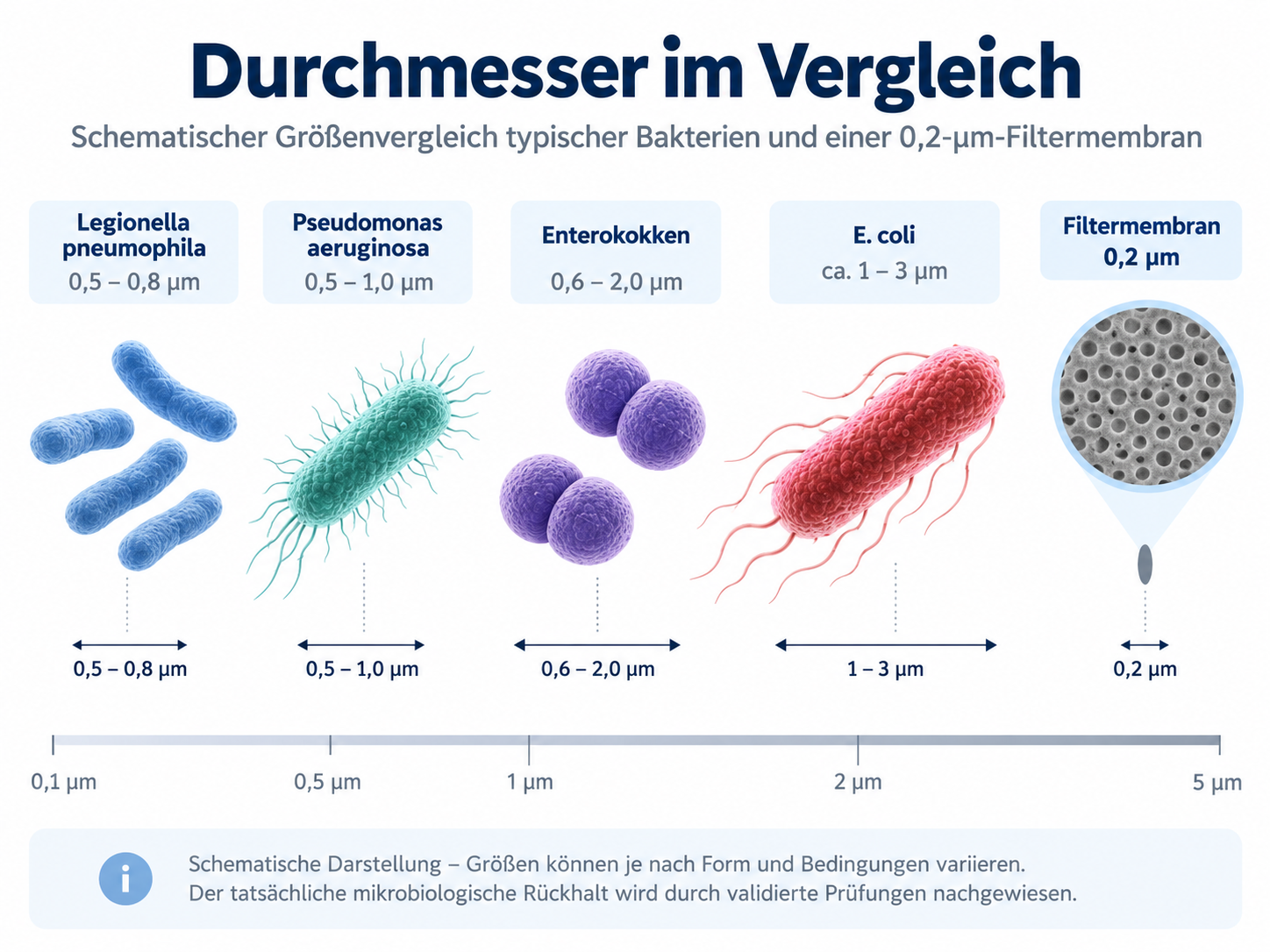
These include in particular Legionella, E. coli and Pseudomonas, as well as other microorganisms for which the respective filter has been validated.
What is a sterilizing-grade water filter?
A sterilizing-grade water filter is a membrane filter used directly at or close to the point of water use, where it forms a microbiological barrier.
The Pall filters used here employ very fine membranes with a nominal pore size of 0.2 µm.
Microbiological retention is not determined solely from the pore size, but is demonstrated by corresponding testing and validation of the filter.
What does point-of-use water filter mean?
“Point-of-use” describes the position of the filter within the installation.
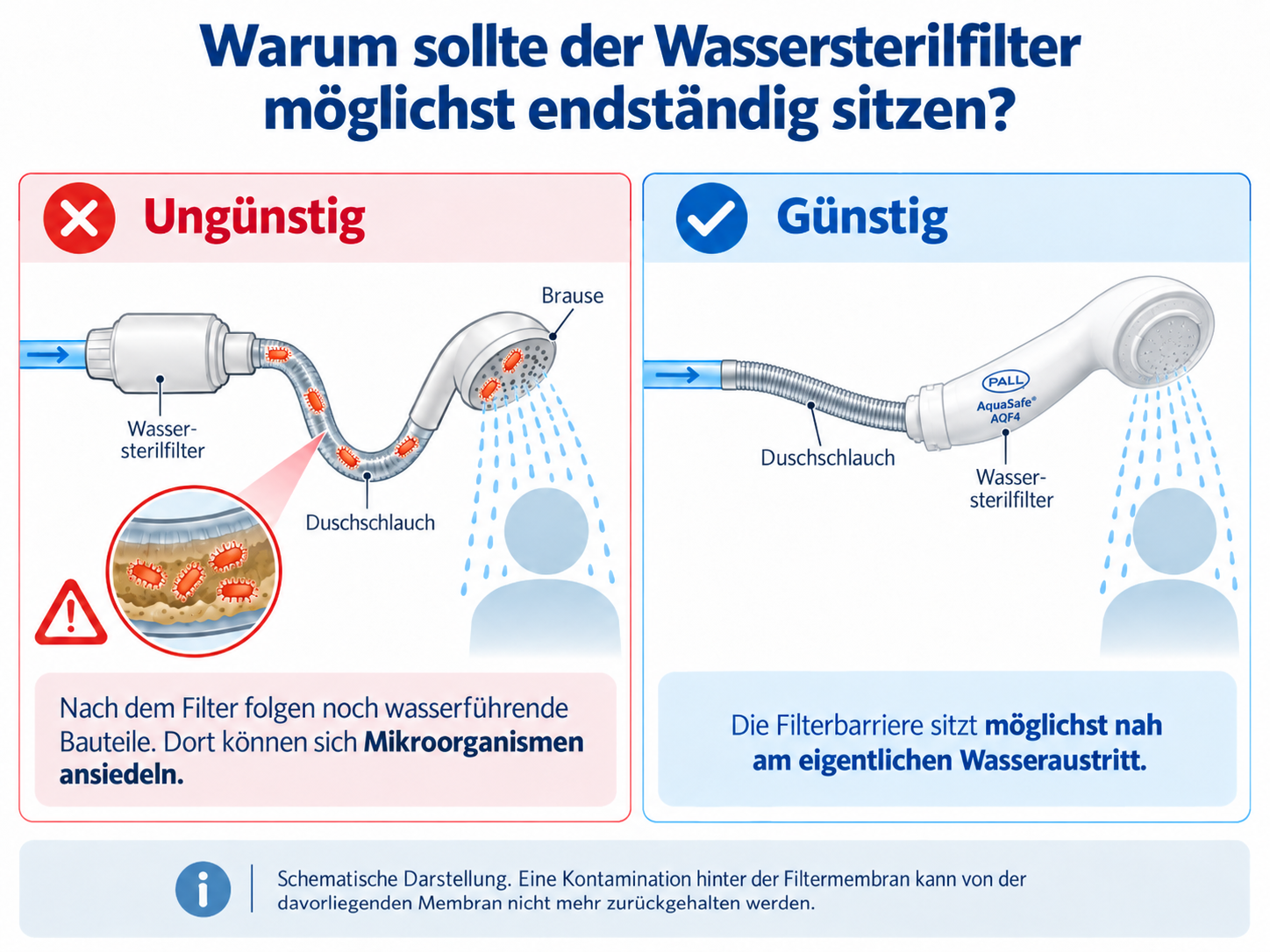
A point-of-use filter is installed as close as possible to the actual point where the water is used or discharged.
The fewer water-bearing components there are downstream of the filter membrane, the lower the risk that already filtered water will subsequently come into contact with contaminated surfaces.
How does a sterilizing-grade water filter work in simple terms?
The principle can be explained in a simplified way by comparing it with a coffee filter: the water passes through, while the coffee grounds are retained by the filter.
In a sterilizing-grade water filter, the barrier is simply much finer.
For a bacterium, the 0.2-µm membrane becomes the proverbial eye of the needle through which the camel would have to pass.
This comparison is intended purely as an illustration. The actual filter performance is determined by the validated retention characteristics of the respective filter.
Why should there ideally be no shower hose downstream of the filter?
The filter membrane can only retain microorganisms that are located upstream of the membrane.
If there is still a shower hose, showerhead or another water-bearing component downstream of the filter, microorganisms can colonize those components.
Contamination on the clean-water side can no longer be removed by the membrane upstream.
For this reason, the actual filter barrier should be positioned as close as possible to the final water outlet.
What is retrograde contamination?
In retrograde contamination, microorganisms reach the filter from the outlet side or from the surrounding environment.
Possible causes include touching the outlet, splash water or contaminated surfaces.
This is why not only the membrane and its pore size are important, but also the design of the filter, hygienic handling and the maximum service life.
Why can changing a filter be hygienically critical?
In filter systems with replaceable filter cartridges, the filter housing is opened during replacement.
If microorganisms reach the clean-water side during the change, they can settle and multiply there.
A filter membrane cannot remove microorganisms that are already located downstream of the membrane.
Hygienic handling during filter replacement is therefore particularly important.
Is a sterilizing-grade water filter only a temporary solution?
Sterilizing-grade water filters can provide an immediately effective barrier at the point of use. However, they do not automatically eliminate the cause of contamination within the pipe system.
If, for example, Legionella contamination is detected in a drinking water installation, the causes must be professionally investigated and, if necessary, technical or hygiene-related measures must be carried out.
Point-of-use filters can provide important additional protection during this period.
In certain applications, sterilizing-grade water filters can also form part of a longer-term hygiene concept. Whether this is appropriate depends on the specific application.
What is the difference between a water filter and a sterilizing-grade water filter?
Water filter is a general umbrella term.
Depending on their design, water filters can retain particles, influence taste, reduce chlorine, soften water or bind certain dissolved substances.
A sterilizing-grade water filter, by contrast, is primarily intended to form a microbiological barrier against water-associated microorganisms.
Household filters and sterilizing-grade water filters therefore perform different functions.
What is the difference between a BRITA water filter and a sterilizing-grade water filter?
Typical household filters from BRITA use, among other things, activated carbon and ion-exchange materials.
They can reduce certain taste and odour compounds and, depending on the system, other constituents of the water.
A Pall AquaSafe or QPoint sterilizing-grade water filter, by contrast, uses a fine membrane for microbiological filtration.
An activated carbon filter is therefore not a substitute for a sterilizing-grade water filter where the retention of Legionella, Pseudomonas, E. coli or other water-associated bacteria is required.
What should I know about activated carbon filters?
Please note: Pall AquaSafe and QPoint sterilizing-grade water filters are not activated carbon filters. The following information is provided solely for comparison between different filter technologies.
Activated carbon has a very large internal surface area and can adsorb certain substances from water.
However, activated carbon does not provide a reliable microbiological barrier against bacteria.
It is therefore particularly important to follow the replacement intervals specified by the respective manufacturer.
If used for too long, after prolonged periods of stagnation, at unfavourable temperatures or where cleaning is inadequate, the hygienic burden within an activated carbon filter system can increase.
An overused or poorly maintained activated carbon filter can worsen water quality instead of improving it.
Is the water fully sterile after passing through a sterilizing-grade water filter?
The term sterilizing-grade water filter does not automatically mean that the water leaving the filter can be described as pharmaceutically sterile water.
The purpose of a point-of-use sterilizing-grade water filter is to create a validated microbiological barrier between the drinking water installation and the user.
What should I consider when using tap water abroad?
The information on this page primarily refers to the situation in Germany.
Germany has high statutory requirements for drinking water. However, these conditions cannot simply be applied to other countries.
Depending on the country or region, the requirements for drinking water supply, water treatment and actual water quality can differ significantly.
In some countries, tap water is treated more intensively with disinfectants such as chlorine. In other regions, tap water is not intended for direct consumption in the same way or travellers may be advised not to drink it.
Before travelling, you should therefore always check the drinking water situation at your destination and not automatically assess tap water according to standards that are common in Germany.
What you should know about tap water when travelling and on holiday
From Kleenpak to AquaSafe and QPoint
Filteria was originally established to clearly separate the non-clinical use of Pall Medical Kleenpak filters from the medical AquaSafe product range.
The Kleenpak product range is no longer manufactured. The corresponding applications are now covered by AquaSafe products or, depending on the requirements, by the QPoint range.
This means that both classic filter solutions with shorter service lives and QPoint systems with a maximum service life of up to 92 days can now be offered.
Our experience with sterilizing-grade water filters
Filteria is part of medishop. Our experience with Pall Medical sterilizing-grade water filters dates back to 2003.
Our expertise is not based on sales alone. We advise customers on product selection, develop our own connection solutions and also carry out installation and filter replacement at customer sites.
As a result, we know the filters not only from manufacturer documentation, but also from their practical use in real drinking water installations.
If you are unsure which filter, adapter or shower solution is right for your application, we will be happy to advise you personally.
Do you have any further questions or are you unsure which filter is suitable for your application?
We will be happy to advise you on choosing the right sterilizing-grade water filter, the correct connection solution and any questions regarding service life, installation and filter replacement.
Simply use our contact page: